Adhesives can connect, fix and protect components, but these tasks are not identical. Defining the requirement as structural bonding, protective potting or joint sealing clarifies what the material needs to do.
Structural bonding: connection and load transfer
Structural bonding joins two or more parts through an adhesive layer. Describe substrates, area, bond-line thickness and loading mode before comparing bond strength, toughness and service environment. Two-part epoxy structural adhesives and acrylic AB adhesives in the ANGUBANG brochure include multi-substrate structural bonding applications.
Potting: filling and component protection
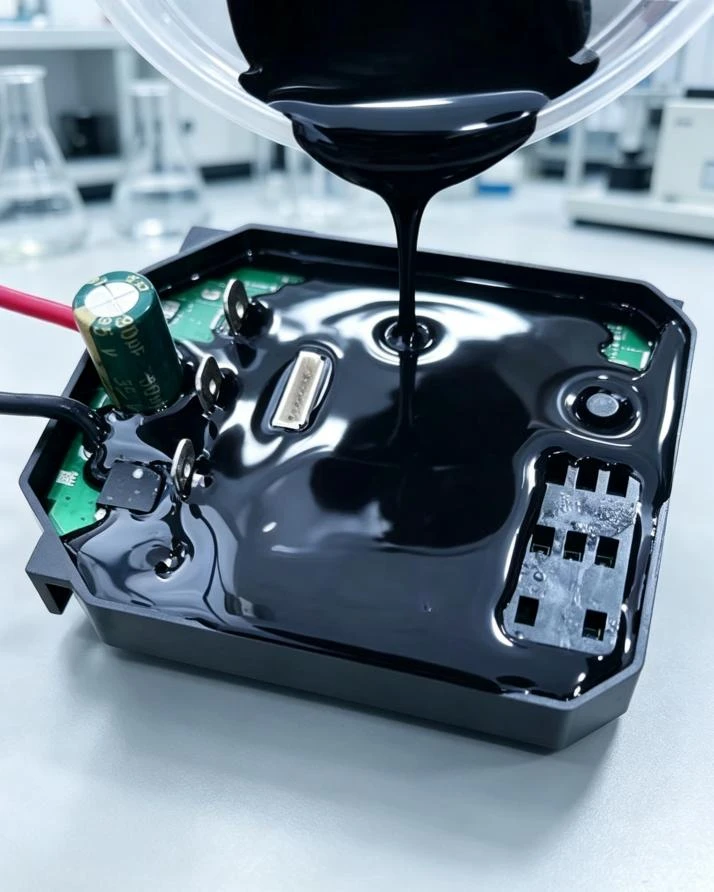
Potting introduces material into a component cavity or an area needing protection. In addition to adhesion, discuss flow and filling, insulation, stress, heat dissipation and protection requirements. Epoxy and polyurethane potting compounds in the brochure offer different models; a single hardness or strength parameter cannot determine overall suitability.
Sealing: joints and interfaces
Sealing protects gaps or interfaces. Assess joint structure, material compatibility, possible movement and the contact environment. UV adhesives, liquid PUR and MS-modified silicone in the brochure cover different assembly or sealing scenarios, but this does not make them directly interchangeable.
Tasks can overlap; validation still needs to cover each one
A potted structure may need both adhesion and insulation, while a housing joint may need both fixing and sealing. List primary and secondary tasks before discussing candidate systems. Final validation must cover the actual structure and product requirements; material category alone cannot confirm suitability.
Discussion Points
| Application Task | Key Discussion Points |
|---|---|
| Bonding | Substrates, bond-line structure, loads and service environment |
| Potting | Fill area, component sensitivity, insulation and heat dissipation |
| Sealing | Joint structure, movement and protection objectives |
Define what the material must do before comparing specific models. This prevents confusing the same material family with the same application.
References
- ANGUBANG Product Brochure · Two-Part Epoxy Potting Compound
- ANGUBANG Product Brochure · Polyurethane Potting / Repair Adhesive
- ANGUBANG Product Brochure · MS-Modified Silicone Adhesive
This article draws on the listed sources as a reference for process discussions. Selection, curing conditions and performance targets require the latest model documentation and validation in the actual application.